
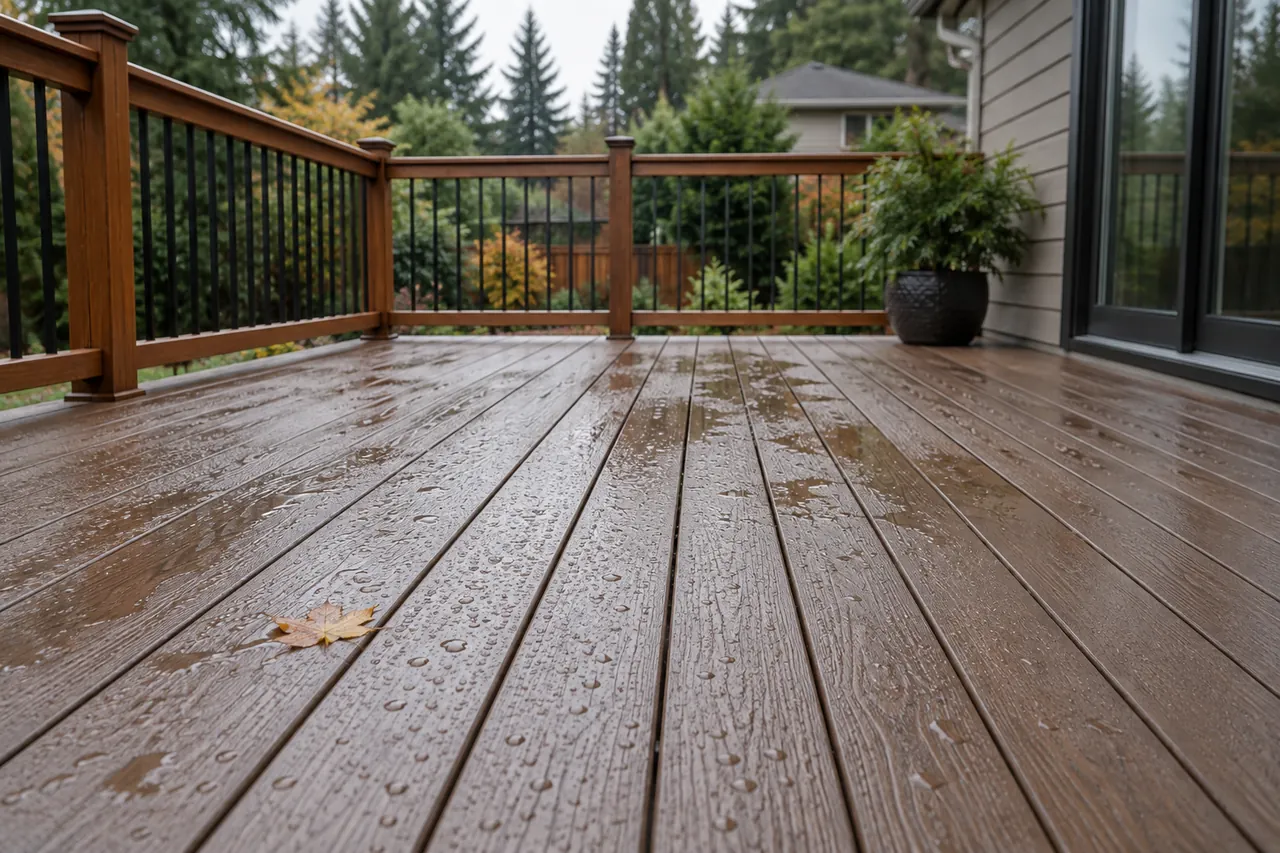
The best decking material for Seattle’s wet climate depends on the site, the budget and the maintenance you will arrange. Capped composite can reduce recurring finish work; Western Red Cedar offers natural wood at a potentially lower initial price; IPE brings dense hardwood character; and PVC deserves consideration where weight or persistent moisture affects the specification. None replaces a well-designed frame and drainage system.
Compare cedar, composite, IPE and PVC for a Seattle deck using the same project scope. The cost tables are planning ranges; your written estimate is based on your own deck. The 37-inch annual-rain figure is a citywide average, so we look at your property’s actual exposure on site. Bring your site conditions, maintenance preferences and material questions to the deck consultation.
| Comparison | Cedar | Composite | IPE | PVC |
|---|---|---|---|---|
| Initial installed-cost position | Lower-cost scenario | Mid-range scenario | Premium hardwood scenario | Premium synthetic scenario |
| Lifespan range — not a guarantee | 15–25 years | 25–30 years | 50–75 years | 30–50 years |
| Maintenance | Clean; maintain selected finish | Clean; inspect surface and structure | Clean; optional oil to retain brown tone | Clean; inspect surface and structure |
| Moisture and decay | Naturally durable wood; still vulnerable | Product/cap dependent; not universally waterproof | Durable hardwood; not immune | No wood core; assembly still needs drainage |
| Appearance | Natural grain and finish variation | Manufactured grain and colors | Dense, variable natural hardwood | Manufactured grain and colors |
| Site questions | Budget, finish care, drying | Collection, heat, shade, support | Weight, sourcing, fastening, upkeep | Roof approval, weight, heat, drainage |
Western Red Cedar: The PNW Classic
Western Red Cedar is closely associated with Pacific Northwest outdoor construction. Its natural grain, aroma and finish choices can be a strong fit for a Seattle home. The Western Red Cedar Lumber Association describes its durability and use in decking; natural rot resistance does not mean decay is impossible.
A $35–$60 per sq ft installed range is a useful planning figure; your written estimate sets the actual price. Grade, dimensions, rails, stairs, access and structural work can change the bid. Compare the same complete project when choosing between cedar and an engineered board.
Cleaning and finish maintenance belong in the ownership budget. A two-to-three-year re-staining cycle is a useful planning figure, not a fixed rule. Follow the finish label, actual wear, moisture and exposure. A shaded north-facing deck in Wedgwood or Maple Leaf may dry slowly, but neighborhood names do not diagnose every site. Graying or checking alone does not establish structural decay; investigate soft areas and trapped moisture.
How long a deck lasts in Seattle rain depends on the material, the build details and the upkeep plan. Compare the cedar vs. composite comparison and the cedar deck building service for grading, compatible fasteners, gaps, ventilation and a realistic finish plan.
Composite: The Default Answer for Most Seattle Homes
Capped wood-plastic composite combines a core with a protective exterior. It can be a practical choice for homeowners who want to reduce sanding, sealing and re-staining.
- Moisture: the cap helps protect the board, but construction, cap coverage, cut ends and installation instructions vary. Composite is not universally incapable of swelling, decay or damage.
- Upkeep: use the selected product’s cleaning method and keep gaps clear. There is normally no recurring wood-stain cycle.
- Warranty: current products offer differing limited warranties. Confirm duration, fade/stain thresholds, exclusions, transfer rules and labor coverage; a 25–50-year label is not a whole-deck lifespan guarantee.
Your written estimate shows the installed price for your deck and gives you a clear comparison starting point. Initial cost, hot dark boards in summer sun, manufactured texture and repeating grain are real purchasing considerations. The composite decking pros and cons guide covers the tradeoffs in detail.
Name the exact collection in the quote. A premium capped board and an older uncapped product have different characteristics; low price alone does not prove poor quality. Compare Trex vs. TimberTech, the composite deck building page, Trex installation and TimberTech builds. Talk with us about your deck, and we will put the exact product line in your written estimate before work starts.
IPE: The 50-Year Deck
IPE, often pronounced “ee-pay,” is a dense tropical hardwood used in demanding exterior settings. Its hardness and durability explain the appeal. The USDA Wood Handbook describes the species group’s high density, hardness and working characteristics; actual stock and installation still matter.
A fifty-to-seventy-five-year lifespan is a long-life scenario, not a guaranteed service period or proof that a deck will outlast every fastener. Similarly, a claimed Class A result must be supported by the exact product’s test and applicable assembly requirements. It does not make wood equivalent to concrete or noncombustible.
IPE can add material, handling, cutting and pre-drilling labor. Specify suitable stainless hardware, end treatment and the supplier’s installation method; weight and support must be designed for the actual deck.
Untreated appearance can weather toward silver; retaining the brown tone may involve a penetrating hardwood finish. One or two oil applications a year is a typical planning figure, not a fixed rule. Even a silvered deck needs cleaning, drainage and structural inspection. Compare IPE vs. composite and the IPE hardwood deck service before choosing.
PVC: Zero Wood, Zero Rot
PVC decking has no wood-fiber core and can offer very low moisture absorption. That advantage applies to the boards, not the wood framing, fasteners or roof below them. Absence of wood does not mean zero water absorption in every test, immunity to stains or freedom from surface algae and moss.
- Rooftops in Capitol Hill or Belltown: compare board weight, support spacing, structural capacity and compatibility with the waterproofing system.
- Waterfront sites: distinguish marine spray at Alki from freshwater conditions in Madison Park. Both need exposure-appropriate details, but Lake Washington is not salt water.
- Deep shade: assess air circulation, debris and drying rather than assume the deck will stay wet every day from October through May.
Use $55–$95 per sq ft installed as a starting range; your written estimate sets the actual price. Modern matte PVC surfaces differ from older glossy products; view the exact color and texture at the site. The PVC vs. composite guide and PVC deck building page explain the complete assembly and value decision.
What Seattle Rain Changes (Whatever Material You Pick)
Repeated wetting makes construction details important across all four materials. Seattle sees 150-plus rainy days a year, so we plan every deck around moisture from the framing up. The aim is to let water drain and allow components to dry.
- Fasteners and connectors: choose the required corrosion resistance for the treatment, exposure and manufacturer’s instructions. Stainless can be appropriate, especially near salt water; approved galvanized products do not universally fail within a few years. Check compatibility throughout the connection.
- Gaps and ventilation: follow the selected board’s spacing rules, preserve runoff paths and provide the required clearances. Debris and blocked airflow can trap moisture around otherwise durable boards.
- Joist protection and flashing: specify compatible protection without trapping water or obscuring inspection needs. Tape does not substitute for sound framing, flashing or drainage.
- Framing and maintenance: composite and PVC often sit on treated wood, although other engineered systems exist. Inspect the ledger, joists, beams, posts, stairs and guards. Our workmanship warranty is in writing, with terms written into your agreement.
The North American Deck and Railing Association publishes deck-safety information. Arrange regular whole-deck inspections and address visible movement, decay or connection problems promptly. Our workmanship warranty is in writing, and your warranty terms are written into your agreement.
The 25-Year Cost Picture
The table below compares construction and upkeep figures for a 300 sq ft deck; your written estimate sets the actual price. It excludes financing, inflation, structural repair and many possible labor costs. Warranty duration does not establish whether a deck will still be serviceable at year twenty-five.
| Material | Initial construction scenario | 25-year upkeep allowance | Arithmetic total | Year-25 condition |
|---|---|---|---|---|
| Cedar | $10,500–$18,000 | $6,000–$12,000 (8–12 finish cycles) | $16,500–$30,000 | Inspect; no guaranteed survival or expiry date |
| Composite | $13,500–$25,500 | About $500 in cleaning supplies | $14,000–$26,000 | Condition and product terms govern |
| IPE | $28,000–$50,000+ | $0–$4,000 optional finish | $28,000–$54,000+ | Cleaning and inspection still needed |
| PVC | $16,500–$28,500 | About $500 in cleaning supplies | $17,000–$29,000 | Condition and product terms govern |
Professional cedar finishing can erode an initial price advantage, while DIY labor changes the comparison. Eight to twelve cycles at $700–$2,000 per cycle would span $5,600–$24,000 over the life of the deck. Ask us to price the finish schedule for your deck so you can compare real numbers.
Composite and PVC still incur cleaning, inspection and possible repair costs; their lifetime cost does not automatically stop after purchase. IPE’s zero-dollar finish option is a color choice, not zero maintenance.
Your Site Matters More Than the Showroom
- South- or west-facing sun, including Ballard and West Seattle view properties: test samples for heat and comfort. Lighter colors or shade may help; a particular PVC or cedar board is not automatically cool.
- North-facing decks and evergreen cover in Wedgwood, Maple Leaf or near Shoreline: evaluate slow drying, needle accumulation and finish access. Composite or PVC can reduce finishing demands, but still needs cleaning.
- Waterfront locations at Alki, Madison Park and Lake Washington: identify marine versus freshwater exposure, humidity, UV and actual spray. Select fasteners and boards for those conditions rather than apply a saltwater rule everywhere.
- Rooftops in Capitol Hill, Belltown and First Hill: the structural load, roof membrane, drainage, fire requirements and approved support system determine suitable materials. PVC is an option to assess, not an automatic engineering approval.
Explore all 58 Seattle neighborhood pages for local deck planning. An actual site visit determines access, slope, exposure and the condition of the existing structure.
So Which Material Should You Pick?
- Choose cedar when the actual installed quote fits the initial budget, natural wood matters and you can arrange the specified cleaning and finish maintenance.
- Choose composite when reducing recurring finish work fits your ownership plan and the exact collection performs appropriately at the site. Compare total cost rather than assume every twenty-five-year scenario favors it.
- Choose IPE when natural hardwood, documented sourcing and long-term use justify the material and installation costs.
- Choose PVC when the selected board’s weight, moisture performance and approved assembly suit a roof, waterfront or persistently damp site. Confirm price and installation requirements.
Frequently Asked Questions
What is the best decking material for a wet climate?
Capped composite and PVC can be useful options where reduced finish upkeep matters, while cedar and IPE can suit a properly detailed wood deck. Identify the product, cap coverage, exposure, drainage and maintenance routine. PVC has no wood core; neither that fact nor a cap makes the whole assembly waterproof or maintenance-free.
How long does a deck last in Seattle?
For planning, compare typical service-life ranges of 15–25 years for cedar, 25–30 for composite, 30–50 for PVC and 50–75 for IPE. These are not guarantees. Condition, installation, treatment, exposure, maintenance and the underlying frame govern actual life; a manufacturer’s limited warranty is a different concept.
Is composite decking worth the extra cost over cedar?
It can be, but use equivalent quotes and your expected ownership period. A professional finish cycle can run $700–$2,000 and repeat every two to three years, depending on exposure. Include labor, supplies, preparation, cleaning and repairs for both options rather than assume composite always recovers its premium.
Do I need a permit to build a deck in Seattle?
Seattle SDCI identifies permit triggers including decks more than eighteen inches above ground, rooftop decks and environmentally critical areas. Low height alone does not settle every case. Check SDCI deck guidance for the actual site and scope; talk with us about permit responsibilities for your project.
What’s the biggest deck-building mistake in the Seattle climate?
Treating premium boards as a cure for poor construction is a major mistake. Specify compatible fasteners, flashing, drainage, ventilation and framing, then inspect the complete deck. Do not assume all galvanized connectors are unsuitable or that joist tape solves every moisture problem.
Talk It Through With a Seattle Crew
Bring the property location, approximate deck size, sun and shade exposure, existing-frame condition and budget to a material conversation. Ask for samples and comparable construction scopes across cedar, composite, IPE and PVC. A showroom sample alone cannot resolve footing, access or roof requirements.
Your written estimate spells out the scope, SDCI permit responsibilities and price before work starts. Our Washington contractor registration is #DBSTTLE287G8, we carry $1 million in general liability insurance with a certificate available for your project, and your workmanship warranty terms are written into your agreement. Call for a site-specific Seattle deck quote.