
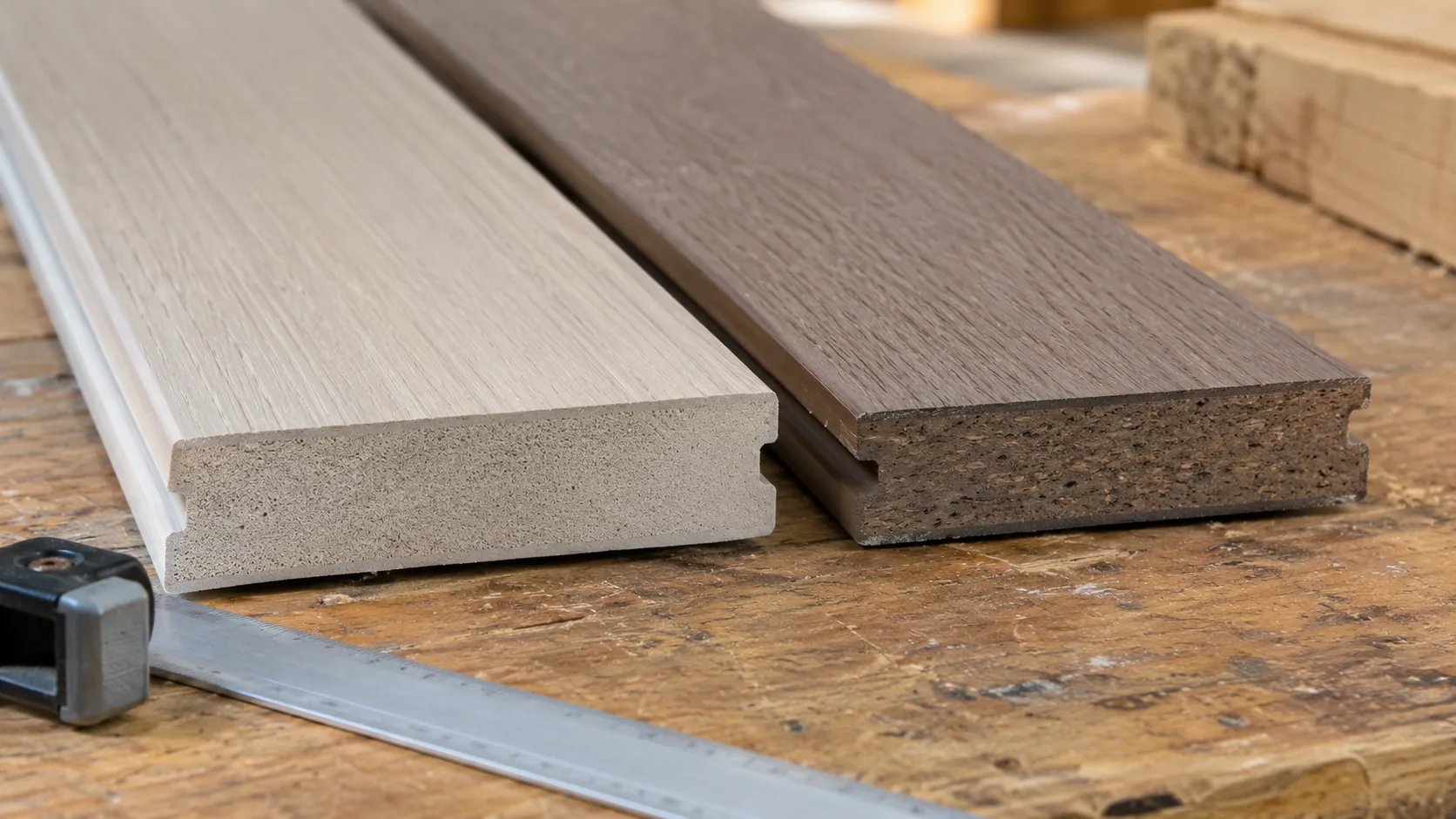
PVC vs composite decking becomes a useful comparison when moisture, weight, exposure and the complete support assembly are specified. Capped wood-plastic composite can fit many backyard projects. PVC’s different core can be worth evaluating for a Capitol Hill rooftop, an Alki waterfront deck or a persistently shaded property.
The choice is not settled by “wood” versus “no wood” alone. Compare the exact board, manufacturer approvals, framing or roof system and total price. Ask about the installer’s experience with the selected product and a similar site.
The Construction Difference, in 30 Seconds
Wood-plastic composite blends wood fiber and polymer; the exact ratio varies. Capped products add a protective exterior, with coverage and core formulation depending on the collection. Do not assume every board is half wood and half plastic or that every exposed cut end requires the same sealant.
TimberTech’s AZEK line is now described through its Advanced PVC collections, and Fiberon also offers PVC products. A cellular PVC core and cap differ from a wood-filled composite. Verify current names and specifications rather than classify a collection from an old brochure.
No wood fiber means the core does not present the same wood-decay mechanism. Grime on the surface can still support algae or moss. In Seattle’s steady rain, cleaning and drainage still shape how a particular assembly ages.
Moisture: Where PVC Is Simply Playing a Different Sport
- Waterfront: identify actual spray, standing humidity, drainage and marine versus freshwater conditions. Composite cut ends or exposed surfaces should be evaluated using the product’s approval and care requirements.
- Rooftop: a shallow space above a membrane can dry slowly. Keep drainage and inspection access open and follow both roofing and decking requirements; PVC does not eliminate the need for airflow.
- Deep shade: evergreen litter, damp surfaces and slow drying warrant a maintenance plan. We check how your deck dries through the wet months before recommending a material.
PVC can have very low moisture absorption, while a suitable capped composite may also perform well within its approved use. Compare test data for the actual products. Neither category permits neglect of the frame, cap damage, fastening or drainage.
Dirt and pollen can support surface growth on either board. Use the specified cleaner and method, and address recurring moisture traps.
Weight: The Rooftop Trump Card
A cellular PVC product may weigh less than a solid composite, but figures such as a thirty-to-forty-percent saving and two-versus-three-plus pounds per linear foot depend on comparable dimensions and current product data. A scalloped or different-width board can change the comparison.
Rooftop design counts the entire dead load—boards, rails, sleepers or pedestals, protection layers and other fixed components—alongside required live loads. The engineer and permitting authority evaluate the assembly, not just the board label. Lighter boards may ease handling through a stairwell or constrained access route without proving that the roof is suitable.
PVC has no wood tannins, but chemical compatibility, heat, drainage and membrane protection still require approval. It is not automatically dimensionally calmer than composite; thermal movement is a separate specification.
Heat, Feel, and Looks
Modern matte PVC finishes and grain textures differ from older glossy products. Evaluate surface feel, sound underfoot, furniture use and appearance in actual daylight. A dense composite can feel different from a cellular board; the support assembly also affects the experience.
TimberTech’s technology guidance describes an up-to-thirty-degree cooler claim for selected Advanced PVC colors with Cool Touch technology compared with traditional composites. That is a product-specific comparison, not a promise for every PVC board or a safe-to-touch temperature. All decking can get hot in direct sun.
Both PVC and composite move with temperature. Follow the chosen product’s exact gapping and fastening instructions, including installation-temperature conditions. A forty-five-degree March morning and an eighty-five-degree July afternoon show why seasonal movement matters; no single gap fits every board. We set gapping for the actual product and the conditions on install day.
Beyond Moisture: Stains, Salt, Scratches, and Fire
- Stains: assess the collection’s resistance and cleaning instructions for wine, grill grease, sunscreen and other spills. Clean promptly; a dense cap does not mean every spill wipes away or every cleaner is safe.
- Salt: select the board and the entire connection system for the actual exposure. Marine frontage at Alki may require greater corrosion resistance, including specified Type 316 hardware. PVC’s core does not make metal connections indifferent to salt.
- Scratches: furniture, planters and abrasive dirt can mark either surface. Cap formulation and finish affect visibility; do not infer scratch performance solely from a softer or denser core. Use compatible furniture pads and lift heavy objects.
- Fire: neither category is automatically fireproof. Class A or B flame-spread results, wildfire listings and roof-assembly requirements are distinct. Verify the exact board’s test report and the proposed assembly; a favorable surface result does not approve an entire multifamily roof.
How Rooftop PVC Actually Goes Down
A rooftop deck needs a support assembly approved for both the selected decking and waterproofing. Boards should not simply lie on a roof membrane. Depending on the system, pedestals or sleepers need a compatible protection layer, correct support spacing, open drainage and access for roof inspection and maintenance.
Avoid penetrations or materials that conflict with the roof warranty. Whether components can be lifted, how loads reach the structure, and how guards are anchored must be designed for the actual system. A general promise that any PVC board “will not interact” with a membrane is inadequate.
Seattle rooftop decks require appropriate permit review. Lower board weight can help a load calculation but does not guarantee it passes. Request the installer’s relevant rooftop experience, the engineer’s scope where needed, and coordination with the roofing manufacturer before accepting a quote.
Price: The Premium and When It’s Worth Paying
Compare material properties and price ranges in the table below. We price the exact product for your deck in a written estimate, so you can decide whether a premium buys something useful at your property.
| Comparison | Capped composite | PVC |
|---|---|---|
| Installed cost | $45–$85 per sq ft | $55–$95 per sq ft |
| Weight | About 3+ lb per linear ft; verify dimensions | About 2 lb per linear ft; verify dimensions |
| Moisture | Product-specific core and cap performance | Very low absorption possible; check testing |
| Heat in direct sun | Color and formulation matter | Selected product claims only; not universally cooler |
| Warranty | Collection-specific limited terms | Collection-specific limited terms; some lifetime product coverage |
| Fit to assess | Backyard, shade and other approved applications | Roof, waterfront and damp-site approved assemblies |
A $10–$15 per sq ft premium on 300 sq ft would be $3,000–$4,500. Your written estimate shows the actual difference for your deck. Compare rails, stairs, frame, access and removal on the same basis.
A ventilated backyard might gain more from improved rails or lighting than a different board. A roof or waterfront project may place more value on a particular weight or moisture specification.
The Third Option Nobody Mentions: Mineral-Based Boards
Mineral-based composite is another category to compare. It uses mineral filler with polymer rather than the same wood-fiber core as conventional wood-plastic composite. Deckorators Surestone technology describes very low moisture absorption and low thermal movement for specific products; those claims should not be generalized to every mineral-filled board.
Compare stiffness, weight, grip, color choices, fastening, spans, gapping and approvals. Lower expansion does not remove all installation gaps. Deckorators’ FAQ states that spacing requirements vary by line.
When comparing MBC with premium composite and PVC, check current colors, local stock, lead time, warranty and project-specific pricing. A shorter product history may limit long-term examples. Rooftop use still requires approval for the exact board and support system; ask for relevant installation experience.
The Verdict
- Consider PVC where the actual board’s weight, moisture performance and approved roof or waterfront assembly justify its price. Examine sun exposure and product-specific heat data rather than assume it always stays cooler.
- Consider PVC for persistent shade when its specifications and cleaning plan suit the property. Longer limited warranty wording is a term to examine, not proof of unlimited life.
- Consider capped composite where a comparable backyard scope provides the value, appearance and feel you prefer. Reasonable sun and airflow help the assembly, but product instructions still control.
- Compare a $3,000–$5,000 PVC premium against spending the same money on rails, lighting or drainage. Our on-site look and written estimate show the real difference for your deck.
If you are still considering cedar or IPE, use the best decking material for Seattle’s wet climate guide to compare the complete field.
Frequently Asked Questions
What’s the difference between PVC and composite decking?
Conventional wood-plastic composite contains wood fiber and polymer, often with a protective cap. PVC has no wood-fiber core. Moisture absorption, weight, heat and movement vary by product.
Is PVC decking better for rooftop decks?
PVC may be a good option when its lower weight and product approvals suit the design. The roof’s capacity, membrane compatibility, support system, drainage, access and guard details still decide suitability. It is not categorically better for every rooftop or automatically approved against every membrane.
Is PVC decking worth the extra cost?
Compare an actual premium with the site’s moisture, load and heat requirements. A $10–$15 per sq ft difference is a rough planning figure; your written estimate sets the actual number. A backyard with appropriate drainage may not need the same specifications as a roof or exposed waterfront assembly.
How long does PVC decking last?
A 30–50-year scenario is not a guaranteed lifespan. UV, heat, surface wear, installation, maintenance and supporting components affect serviceability. TimberTech warranties distinguish current collections and coverage; lifetime product wording and fade/stain coverage are not identical.
Does PVC decking look like plastic?
Appearance varies from older glossy surfaces to current matte grains. Compare physical samples outside, next to siding and railings, and at normal viewing distance. Texture, sound and feel are personal preferences; ask how to obtain samples of the products you are considering.
Get the Right Board for Your Site
Request quotes for PVC decks, composite decks or rooftop decks with the exact product and assembly specified. Include inspection access, roof protection, corrosion resistance and permit responsibilities where relevant.
Call us for a free phone consultation, no obligation, and we will discuss whether your site warrants PVC or whether an approved composite scope is more suitable. You get a written estimate before work starts, and your warranty terms are written into your agreement.