
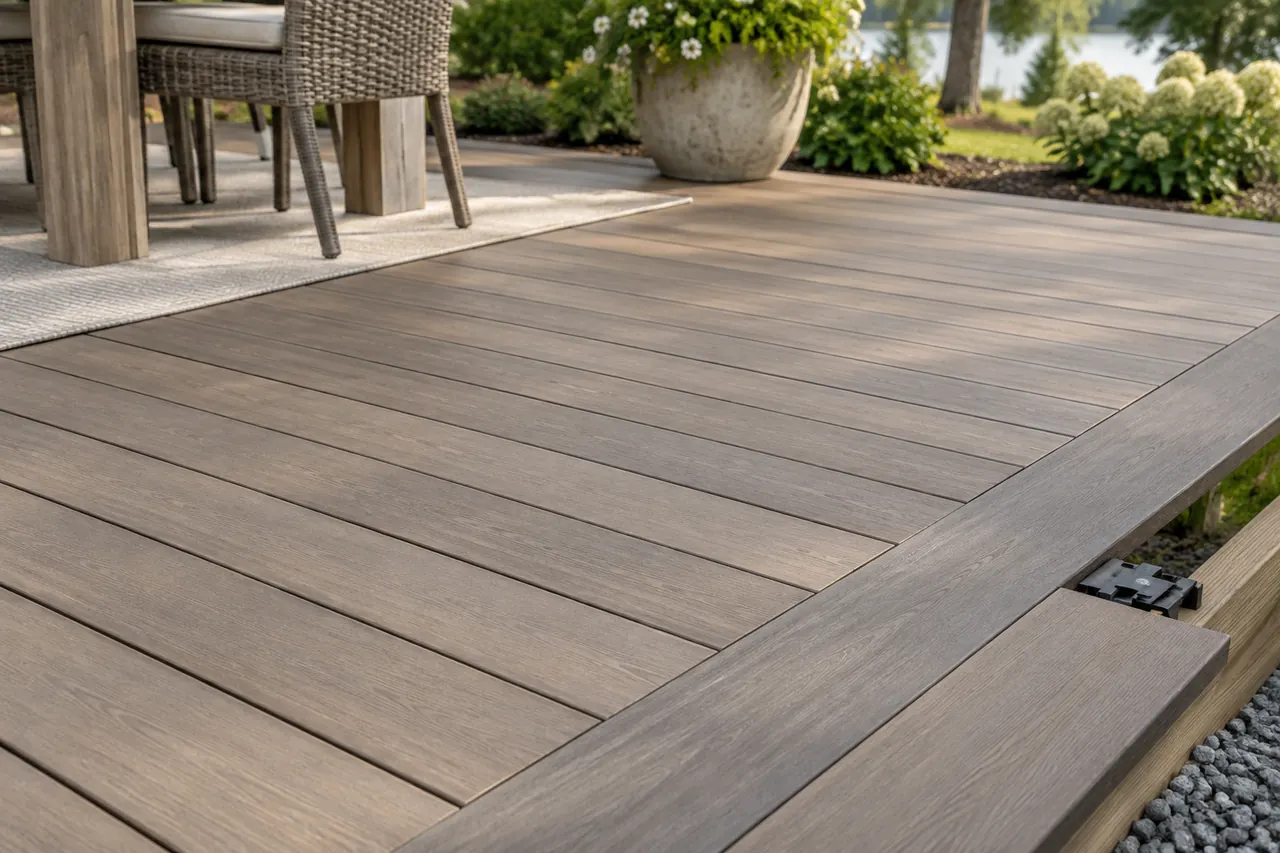
Composite decking pros and cons are most useful when they help you compare a real Seattle project. Less recurring finish work, product choice and warranty documentation can be advantages. Initial cost, surface heat, manufactured appearance and installation requirements can be reasons to consider another material.
Compare composite decking by the exact collection, frame, installation requirements and maintenance plan. Look at the benefits and tradeoffs for your Seattle home, then ask the contractor to explain how the selected product fits the written proposal.
The Pros (and Why They’re Bigger in Seattle)
- 1. Less finish work. Many capped products avoid recurring sanding, sealing and wood-staining cycles. That can simplify upkeep in a rainy climate, but it does not eliminate cleaning or structural inspections. Seattle’s weather, with about 37 inches of rain a year, is a planning factor; we schedule finish work around your site’s conditions.
- 2. A protective cap. The cap technology Trex and others use helps protect the core. Cap configuration and product generation vary from line to line. Follow the actual installation and care requirements.
- 3. Written limited warranties. Major products offer different fade/stain and product terms, sometimes between twenty-five and fifty years. Confirm transfer rules, thresholds, exclusions, claim procedures and whether labor is included. A warranty can document the purchase without guaranteeing resale value.
- 4. A different surface from aging lumber. Composite avoids natural wood-grain splintering, but damage, sharp edges or failed fasteners can still create hazards. Check the surface regularly on a deck used by children, pets or bare feet.
- 5. A selected color palette. Manufactured boards offer coordinated colors and textures. Batch variation, weathering, stains and later replacement stock can still affect the match; keep product records and review physical samples.
- 6. A coordinated system. Fascia, stair risers, approved hidden fasteners, lighting and railing options help build a complete outdoor room. Some specific products support heat-forming for curves using approved methods. Neither all boards nor all accessories are interchangeable, and wood decks can also use planned, coordinated details.
What “Near-Zero Maintenance” Actually Means
Plan regular cleaning appropriate to the selected board, clearing pine needles and debris from gaps, and checking drainage. Inspect railing connections and the structure below the surface. A spring wash and extra cleaning under trees may be useful checkpoints; follow the product’s actual schedule and cleaner instructions.
Composite can reduce finishing chores while its supporting wood, connectors, flashing and guards still require attention. A faded or dirty surface and a structurally unsafe deck are different problems.
The Cons: Real Ones, Not Brochure Cons
- 1. Initial price can be higher. Composite usually costs more per square foot to install than cedar, and the difference depends on the collection and the site. We can price both options side by side in a written estimate. A short three-year ownership horizon can favor lower initial cost.
- 2. Dark boards can become hot. Test samples in the same summer sun, especially on south- and west-facing decks in July and August. Lighter colors and shading may help. Some selected PVC products advertise cooler performance; PVC is not universally cool or safe for bare feet.
- 3. It remains a manufactured material. Repeating grain, finish and feel differ from real cedar. Inspect samples close up and at normal viewing distance. The cedar deck service addresses homeowners who prioritize natural wood and accept its care needs.
- 4. Deck boards are not the whole structure. Verify the selected decking’s approved use; ordinary surface boards do not replace joists, beams or posts. Inspect flashing, ledgers, fasteners and ventilation. NADRA provides whole-deck safety resources. The board and the frame both need appropriate care.
- 5. Temperature movement affects installation. Follow the exact end-gap, side-gap, fastening and temperature instructions. Boards installed without required movement allowance can deform or load connections. Our team explains these details before work starts instead of assuming wood-deck habits transfer unchanged.
- 6. Product generations differ. Older uncapped boards, current capped entry collections and premium lines are not one specification. Board prices vary widely by collection and length. Compare actual SKUs, warranties and approvals; price alone is not proof that a board will fail or that every inexpensive composite is worse than cedar.
The 25-Year Math, Worked Out
For a 300 sq ft deck, a typical cedar build runs $10,500–$18,000. Nine finish cycles at an average $1,200 add $10,800. That arithmetic yields $21,300–$28,800 before repair costs, inflation or other upkeep.
The same deck in composite starts at $13,500–$25,500 and adds about $500 in cleaning supplies, giving $14,000–$26,000. That excludes cleaning labor, inspections, structural repairs and any replacement. Manufacturer coverage may be expired, prorated or subject to exclusions at the comparison date; being within a stated duration does not guarantee a covered claim.
A six-to-ten-year crossover can occur under selected assumptions. Compare your actual initial-price difference against realistic annual upkeep savings, then consider financing, repair timing, sale plans and your willingness to do finish work yourself.
How to Buy Composite Without Getting Burned
- Review samples at the property. Gray daylight, direct sun and nearby siding can change how a color reads. Ask whether samples can remain long enough to compare conditions.
- Put the line name in writing. Brand, collection, color, board profile, fastener system and quantities belong in the bid. A generic “composite deck” price does not identify what you are buying; prices can differ widely between product lines.
- Ask how the frame is protected. Discuss compatible flashing and joist protection, fastener corrosion resistance, clearance and ventilation. Stainless hardware is not a universal substitute for following approved connector specifications.
- Know who covers what. Manufacturer product warranties depend on the product line, purchase date, registration and claim. The warranty terms for your project are written into your agreement.
So Is Composite Decking Worth It?
Composite can be worthwhile when reduced finishing effort fits the way you use and maintain the property. A seven-year or longer ownership horizon, shade, tree cover or a busy household may justify examining the life-cycle numbers, but none proves the premium pays back. We can walk through those numbers for your deck on a free phone consultation.
Rentals and ADUs can benefit from a clear, manageable maintenance plan; they still need someone responsible for cleaning, inspection and repairs. No material promises a decade without a maintenance call. Families should assess heat, traction and damaged edges as well as appearance.
Cedar may fit a strict initial budget or a strong preference for real wood. Avoid paying a premium without knowing the exact product and scope. Once composite looks appropriate, compare Trex vs. TimberTech and the wider best decking material for Seattle’s wet climate guide before selecting a collection.
Frequently Asked Questions
What are the main disadvantages of composite decking?
The main considerations are initial installed cost, heat in direct sun, manufactured appearance and feel, and product-specific installation requirements. Installed composite can run $45–$85 per sq ft, and your written estimate shows the price for your deck. Surface boards do not remove the need for a sound, inspected frame.
How long does composite decking really last?
A 25–30-year service-life scenario and 25–50-year limited warranty are different comparisons. Neither guarantees how long your entire deck will last. Product generation, support, exposure, care and frame condition matter; check the actual manufacturer document.
Does composite decking get moldy in Seattle?
Mold, algae or moss can grow on accumulated dirt and pollen on outdoor surfaces. Cleaning requirements depend on the board and product generation. A cap does not make every board immune to staining or damage, and cleaning the surface does not inspect the frame.
Is composite decking slippery when wet?
No outdoor deck is slip-proof. Texture, contamination, water, ice, footwear and wear affect traction. Compare the exact product’s testing where relevant and keep the surface clean; do not assume every modern composite outperforms all wood in the wet.
Can composite decking be installed over an existing frame?
Sometimes, after the frame, ledger, footings, connections and supports are assessed. Match the selected product’s spans, stairs and diagonal-layout rules; sixteen-inch on-center spacing is common guidance for some products, not a universal approval. A frame’s age, including fifteen years, alone does not decide whether it can remain.
Get a Straight Answer for Your Deck
Request a site-specific comparison that connects budget, exposure, existing-frame condition and product selection. Ask why a particular collection earns its premium and what would change if you selected cedar or another material. The composite deck we build service page explains the construction scope.
Our Washington contractor registration is #DBSTTLE287G8, we carry $1 million in general liability insurance with a certificate available for your project, and your workmanship warranty terms are written into your agreement. You receive a written estimate before work starts. Call to ask about a free phone consultation, with no obligation.