
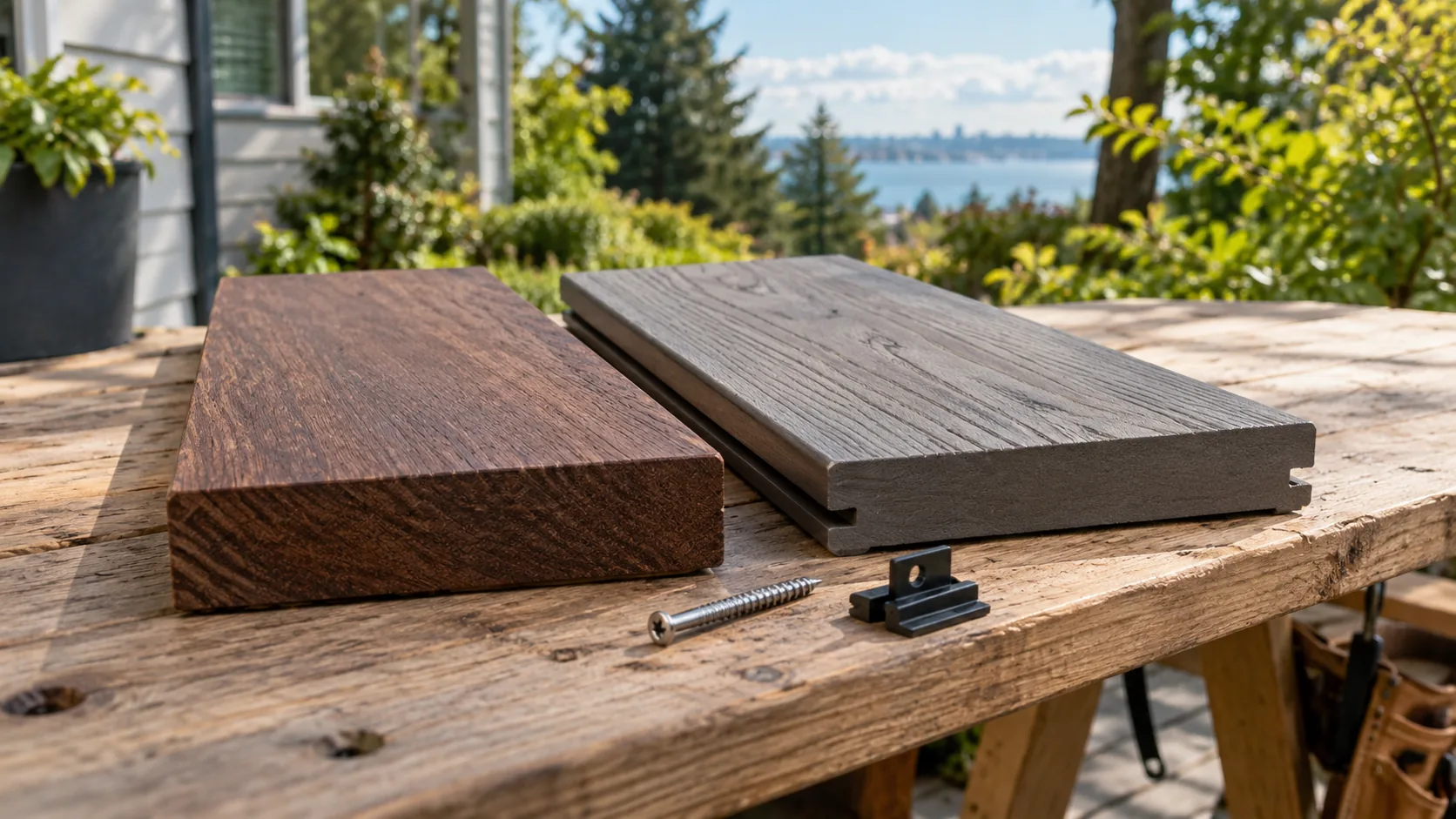
IPE vs composite decking is a choice between dense natural hardwood and an engineered surface, with different purchase and maintenance priorities. Both can be considered for Seattle rain when the complete deck is designed appropriately. Neither is a promise of zero maintenance or a deck that outlasts every future owner.
Compare IPE hardwood and composite decking around your Seattle property, installed scope and ownership horizon. A 37-inch annual-rain example is not a measurement of exposure at your home; shade, drainage and maintenance affect both materials.
What Makes IPE Different From Every Other Wood
IPE is a commercial hardwood name associated with a group of dense tropical species.
The USDA Wood Handbook describes IPE’s high density, hardness, durability and machining difficulty. Those properties support careful drilling and tooling choices. They do not establish immunity to every insect, decay mechanism or installation defect.
Obtain species and supplier documentation for the stock and design the framing and connections for their actual service conditions.
A claimed Class A fire result needs the relevant test report and product/assembly scope. It does not mean IPE is noncombustible like concrete or slate. Brown color, tight grain, natural variation and a solid feel are reasons to inspect samples; temperature and comfort still depend on color, sun and exposure.
The Cost Gap (and Why It’s Not the Whole Story)
The figures below are general comparison ranges; your written estimate sets the price for your deck. A full-project range can include a different footprint or railing scope from a per-square-foot example; compare equivalent proposals.
| Comparison | IPE | Premium composite |
|---|---|---|
| Installed-cost scenario | $70–$130+ per sq ft | $55–$85 per sq ft |
| Full-project scenario | $28,000–$65,000 | $16,000–$30,000 |
| Typical service life | 50–75 years; not a guarantee | 25–30 years; not a warranty |
| Cost per year | Depends on actual useful life and upkeep | Depends on actual useful life and upkeep |
| Warranty questions | Supplier and workmanship terms may exist | Collection-specific limited product/fade/stain terms |
IPE can increase lumber, freight, handling, cutting and pre-drilling labor. Dense stock needs suitable blades and compatible fasteners; installation time depends on the system and site.
For a simplified example, $40,000 divided by sixty years is about $667 a year, while $22,000 divided by twenty-seven years is about $815. That arithmetic excludes financing, discounting, maintenance, repairs and the uncertainty of those lifespans. It does not prove a homeowner keeping the property for ten years will recover the IPE premium.
An attractive hardwood deck can be a selling feature, but no resale uplift is guaranteed. Composite warranty transferability can also be useful documentation, subject to its terms. IPE is not automatically sold without any warranty merely because it is wood: check supplier, product and contractor promises separately.
Maintenance: The One Honest Knock on IPE
Decide whether you prefer IPE’s brown appearance or natural weathering toward silver. Unfinished IPE commonly silvers within one to two years, and holding the brown tone can take one or two oil applications a year, depending on exposure. Retaining color requires the selected hardwood finish’s cleaning, preparation, drying and application instructions.
Allowing a silvered appearance does not mean never touching the deck again. Clear leaves, check gaps and drainage, clean with an approved method, and inspect boards, fasteners, rails and the frame. Likewise, composite is not “set and forget”; its cap does not eliminate cleaning, damage checks or every possible fade claim.
- Composite calendar: inspect after winter and clean using the actual product’s guide. Tree cover may require additional debris removal and a fall cleaning. A stiff brush or pressure washer is not approved for every product.
- Silvered IPE calendar: clean, clear drainage and inspect the assembly even when no color-preserving oil is selected. Uneven exposure can create uneven weathering.
- Oiled IPE calendar: inspect the coating, prepare and dry the wood as directed, then apply the specified amount. Full sun may affect the interval.
Missing an oil application can affect appearance, and deferred maintenance can affect deck condition. Cleaning and structural maintenance remain separate from color preservation. For another wood-versus-engineered comparison, see the cedar vs. composite comparison.
IPE in Seattle Rain, Specifically
Rainfall alone does not determine IPE performance. Moisture change, board condition, stock acclimation, fastening and airflow influence movement. Dense wood can still cup, check or experience problems in an unsuitable assembly.
- Gapping: follow the supplier’s instructions for actual board dimensions, moisture and installation conditions. Seasonal moisture changes matter, so we set gaps for the conditions on install day.
- End sealing: specify the supplier’s required end treatment and when freshly cut ends should receive it. Do not substitute any wax or coating without confirming compatibility.
- Ventilation: establish required ground clearance, airflow and open drainage paths for the selected system. We confirm clearance on site so the boards can dry between Seattle rains.
An exposed deck may weather differently from one beneath evergreens. Needles, stains and shade can create uneven color; clean before any refinishing and follow approved products. Moss or algae can sit on dirt on hardwood too. Density does not make a slippery or dirty surface incapable of contamination.
Look, Feel, and the Ten-Foot Test
Premium composites can offer matte surfaces, embossed grain and multiple tones. At ten feet the visual distinction may be subtle; at two feet you may prefer natural grain variation or a particular manufactured texture. Examine full-size samples and installed examples rather than treat viewing distance as a performance test.
IPE’s dense feel and natural color variation are different from composite’s formulation and pattern. Surface temperature varies by board and color, so we don’t assume one material is always cooler underfoot. Test comparable samples in the same direct sun, especially on a south-facing deck, and consider shade and barefoot use.
Decide whether you like fresh brown wood, maintained oil, weathered silver or a selected composite tone. Appearance is a preference to discuss alongside cost and care, not evidence that one material is always superior.
Weight and Installation
IPE is dense hardwood, so board weight matters to the structure. A board foot measures volume; compare products at the same dimensions and area. Obtain actual board weights and include the whole assembly in the structural dead-load calculation.
Dense hardwood generally demands suitable carbide tooling, careful pre-drilling and an approved screw or clip system. Confirm corrosion resistance, end treatment, gaps and movement allowances. Hidden fasteners can produce a clean appearance where approved; not every IPE board or layout uses the same attachment method.
The deck professionals at NADRA provide industry and safety resources. Weigh the hardwood experience the job calls for and the project’s structural complexity before attempting the work yourself.
Composite may be easier to cut and handle in some situations, but still has specific fastening, support, stair and thermal-gap requirements. Review the lines on trex.com and the composite deck building service for a complete quote.
Sourcing: The Question You Should Ask Any IPE Builder
Ask for the actual species, country of harvest, importer and legal supply-chain documentation for tropical hardwood. The USDA APHIS Lacey Act guidance explains that illegally harvested plant products cannot be imported into the United States and that certain products require declarations.
If a supplier claims FSC certification, verify the certificate and the claim on the actual order through FSC Search. Certification, legal harvesting and an importer’s paperwork are related questions, not interchangeable labels. Ask us about the sourcing for the boards on your project.
Composite may incorporate reclaimed wood and plastic, but recycled content, sourcing and end-of-life handling vary by product. It does not automatically sidestep every environmental question. Compare documented supply chains, transport, maintenance and disposal rather than assume one category is universally sustainable.
The Verdict
- Consider IPE for long-term ownership when documented hardwood sourcing, natural appearance and the actual installed quote fit your priorities. Your written estimate shows the actual installed price for your deck.
- Evaluate IPE carefully for waterfront architecture and prominent outdoor rooms, with exposure-appropriate fasteners, support and upkeep. The site must justify the complete specification, not merely a premium label.
- Consider composite when a lower comparable initial bid, reduced finishing and documented warranty terms fit the ownership plan. We can price both materials on the same scope so you can compare them directly.
- For a potential sale in ten to fifteen years, compare actual cost, condition, buyer preferences and any transferable coverage. Neither material guarantees resale recovery, and neither requires zero maintenance.
Include cedar and PVC in the best decking material for Seattle’s wet climate comparison if either might fit your site or budget.
Frequently Asked Questions
Is IPE worth the cost over composite?
It depends on the actual bids, natural-wood preference, ownership horizon and maintenance plan. The fifteen-plus-year and fifty-to-seventy-five-year examples do not establish payback for a particular house. Compare service-life scenarios and resale uncertainty alongside warranty transfer terms.
How long does an IPE deck last in the Pacific Northwest?
Fifty to seventy-five years is a long-life scenario, not a guarantee. Actual life depends on species, stock, design, exposure, fasteners, upkeep and the supporting frame. Durability does not mean immunity to every form of decay or insect damage. Require product evidence and a sound assembly.
Does IPE decking require maintenance?
Yes. Cleaning, clear drainage and inspection remain necessary whether the wood is oiled or allowed to silver. Oil may help maintain brown color; follow the selected finish’s instructions instead of assuming one or two applications suits every exposure.
Is IPE good for waterfront and lakefront decks?
IPE can be considered for waterfront work, but identify freshwater versus marine conditions. Alki salt spray and Lake Washington exposure are not identical. Type 316 stainless can be relevant in salt environments; verify the actual fastener and connector requirements rather than assume an inland type is interchangeable.
Can I install IPE decking myself?
It requires appropriate drilling, blades, handling, end treatment, fastening and moisture-movement details, plus a suitable structure. Our team handles those details and puts the installed price in a written estimate before work starts. Evaluate the scope and your qualifications; complex elevated or waterfront work needs appropriate professional design and execution.
Price Your Deck Both Ways
Request written prices for IPE hardwood decks and composite decks using the same footprint, stairs, railing, demolition, access, frame and permit scope. Review samples at the property and identify the expected care for each surface.
Call us for a free phone consultation about both material scopes. We explain each option and its exclusions before you decide, provide a written estimate before work starts and write your warranty terms into your agreement.